
Africa After Dark: We Scored 73 Parks to Find the Best Night Safaris on the Continent

To the untrained eye, the African bush at midday and the bush at midnight look like two different planets. By day, a game drive is sensory overload — vivid colour, vast horizons, your vision stretching for miles as you scan for a dust cloud kicked up by heavy hooves or the flash of a cattle egret lifting off.
Guides have the luxury of numbers: multiple vehicles, a whole traversing network talking to each other, lion tracks pressed clearly into the dirt, and the confidence to follow them on foot. Daytime safari is abundance, clarity, almost familiarity.
Then the sun drops, and the rules change.
At night, the bush shrinks to the width of a spotlight beam. Your world concentrates into that single circle of light, which means the place you choose to be matters immensely. Pure darkness, done properly, is beautiful but there’s a specific frustration unique to the night drive, and it’s one no guide can fully hide from: the ambient glow of a distant village, a lodge that hasn’t dimmed its lights, the headlights of another vehicle crossing your beam, or the flat disappointment of driving around with nothing to follow. Worse still is bad guiding; a spotlight blasted straight into an impala’s eyes, leaving it lit up and vulnerable to whatever’s stalking it.
A truly great night drive needs pristine isolation.
An unspoiled sky where the Milky Way is bright enough to distract you from the search itself, real time with active predators, a leopard slinking through woodland, hyenas squabbling over a kill, and a guide who respects the animal enough to use a soft red filter or indirect white light, watching without disturbing.
Finding anything in the pitch dark is an art form rooted in biology. Without daylight’s safety net, guides fall back on an older toolkit. We track the eerie green glow of the tapetum lucidum — the reflective layer behind an animal’s eye that throws torchlight straight back at you. Cooler, denser night air carries sound further and cleaner, so you learn to stop, cut the engine, and listen: a territorial call, an alarm bark, the crackle of dry leaves or the slosh of something moving through water nearby.
Choose the right place (low vehicle density, high wildlife density) and the payoff is enormous. The overstimulation of daytime gives way to something quieter and more electric. You tuck a blanket over your knees, slip on clear glasses to keep the night insects out of your eyes, and your senses do the rest. Sounds you don’t recognise turn out to be frogs or crickets. You notice the smell of the earth and the evening flora. During the night drive briefing, you’ll hear about the rhodopsin cycle — how the eye adapts to darkness — and then the engine goes off, the lights go off, and a laser pointer walks your eyes across the Milky Way instead.
None of that happens by accident. It happens because of where you are.
Why we built an index
Here at Yellow Zebra, we’re one of the world’s true destination specialists. Our team is built from genuine safari specialists, all of whom have spent considerable time living and working in Africa. This index was set up by our Founder Julian Carter-Manning – a Condé Nast recognised travel expert – and our Brand Manager Andrew van den Broeck. Julian set up Yellow Zebra and has travelled ‘Safari Africa’ extensively for 25 years, “from the Congo to Cape Town” as he likes to put it, whilst Andrew is one of the most experienced professional safari guides in the industry.
Our team is built entirely of professional safari guides, lodge managers and people who have spent considerable time living in Africa. And the team regularly returns to destinations across Africa to refresh knowledge and learn more about new destinations. Between us all, there’s over 600 years of on-the-ground experience across every country in this study and with every major safari operator. That’s the qualification behind the opinions here — but we didn’t want to rely on opinion alone.
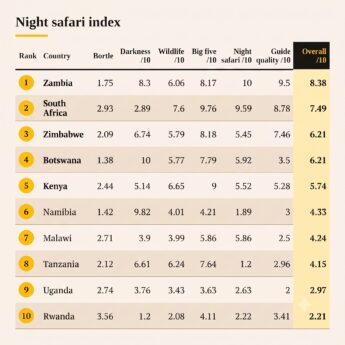
So, we went looking for the data that actually determines whether a night safari drive delivers: is it even permitted where you’re staying? What will realistically be moving out there after dark? How rigorously are the guides trained for it? And how dark is the sky, not as a national average, but park by park? We scored 73 parks and reserves across the continent on exactly those four factors, weighted, and rolled them up by country. The results reshuffle the conventional wisdom on where to go.
Zambia
Zambia tops the index, and the reason is structural: night driving here isn’t a private-concession workaround, it’s built into the national park system itself. Zambia’s own guide qualification, ZAGOTA Level 2, explicitly certifies guides for night vehicle safaris — a rare, deliberate recognition that this is a discipline of its own.
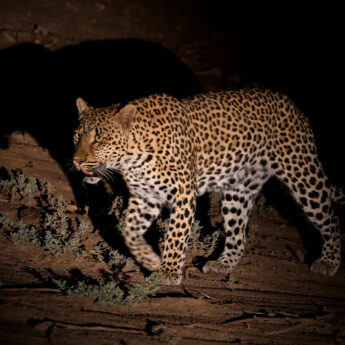
South Luangwa is the standout, arguably the best leopard-at-night destination on the continent, with honey badger, civet, genet, bushbaby and porcupine all realistic in a single drive. Lower Zambezi and Kafue offer the same after-dark access with a wilder, far quieter feel, exactly the low-vehicle, high-wildlife balance that makes the difference between a good night drive and a great one.
South Africa
South Africa doesn’t lead on any single factor, but it’s the most complete package on the continent: the strongest Big Five score in the index, a huge network of private reserves running night drives as standard, and Kruger National Park itself operating organised guided night drives. It’s one of the only state-run parks in Africa to do so.
Sabi Sands is the headline act. Sighting for sighting, probably the finest leopard-at-night experience anywhere, with Timbavati, Madikwe and Manyeleti all delivering a similarly rich nocturnal cast.
Zimbabwe
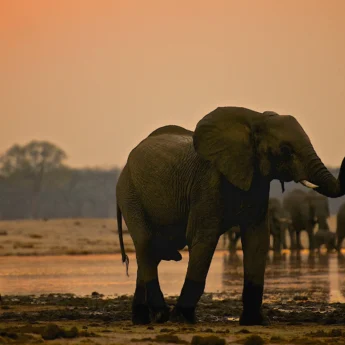
Zimbabwe’s guiding framework is, by some distance, the toughest on the continent to earn, requiring law, ecology and firearms theory under a registered mentor before a guide even reaches entry level. That rigour shows in the field. Hwange and Mana Pools run night drives through private concessions bordering their national parks, with brown hyena and aardwolf both possible in the drier southwest.
Botswana
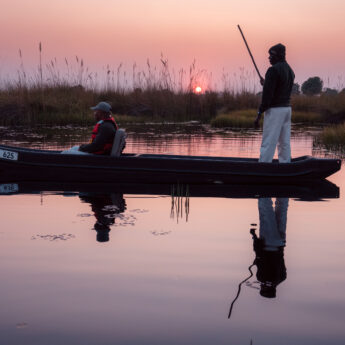
Botswana scores lower on guiding but tops the index on darkness. Its remote concessions in the Okavango Delta, Linyanti and Khwai sit under some of the least light-polluted skies we measured anywhere. Night drives here run almost entirely through private concessions rather than government reserves, which means fewer vehicles crossing your beam and a genuinely private experience of the dark.
Kenya
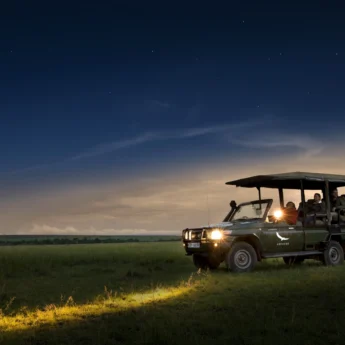
Kenya’s Big Five and species scores rival anywhere on the continent, but its most famous reserves (the Maasai Mara among them) don’t permit night drives at all. The real story is in the conservancies bordering them: Greater Mara, Laikipia and Lewa-Borana all allow night drives and turn up serval, aardvark and striped hyena.
Namibia
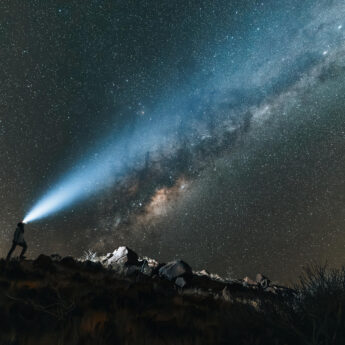
Namibia doesn’t rank highly overall (its parks largely prohibit night drives) but it holds something that nothing else in the index can match. At Etosha’s floodlit waterholes, rhino, lion, hyena and porcupine arrive after dark; you simply sit, and wait, and watch for them all to appear. Pair that with NamibRand, a Gold-Tier Dark Sky Reserve, and Namibia stops being a night-drive destination and becomes something else entirely – arguably the best stargazing safari on the continent.
The measure that actually matters
Because in the end, none of this is really about a scorecard. A great safari isn’t calculated in stats or coordinates — it’s the place, the hospitality, the food, the drinks around the fire, the way the whole experience sits with you afterwards. It’s the story you tell when you get home. And no story is better carried than by its characters, the wildlife you encountered, and the person who found it for you in the dark.
Our 12 cross-country specialists (professional guides, lodge managers and highly experienced guide trainers among them) have travelled to every major safari country extensively. They know the mid to luxury safari market thoroughly and are well recognised across the industry as some of the very best experts in the business. Each specialist has named their own top three guided experiences by country, drawn from real drives, not spreadsheets. It’s on that pairing, data on where the conditions exist, and judgment on who delivers within them, that we build every night-safari itinerary around.
Talk to us about where in Africa the dark is done properly.
Speak to an Expert
Let one of our Yellow Zebra specialists design
your tailor‑made African adventure