10 Interesting Facts About the Great Migration

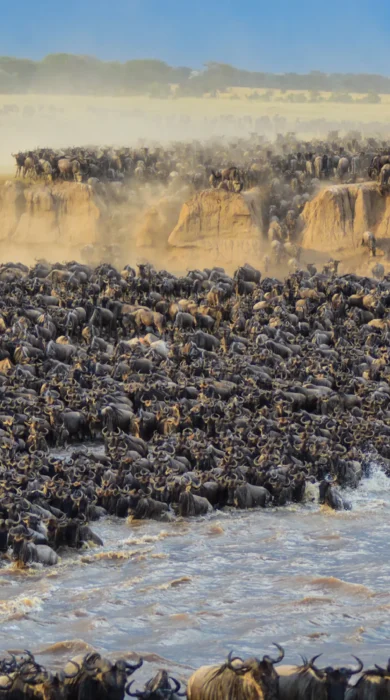
The Great Migration is one of the most spectacular wonders of the natural world! Every year, millions of herbivores move roughly clockwise throughout Tanzania’s Serengeti and Kenya’s Maasai Mara, following the rains in search of green pastures and good water.
What is the Great Migration?
The Great Migration is the largest overland migration in the world, it is made up not only of 1.5 million wildebeest, but also 200,000 zebra, and smaller numbers of Grant’s gazelle, Thompson’s gazelle, eland, and impala.
When and where are wildebeest calves born, and can they keep up with the herd?
Wildebeest calves are able to walk as soon as they are born. Half a million wildebeest calves are born each year in the Southern Serengeti at the start of the yearly migration cycle, between January and March. Most are born in mid-February when approximately 8,000 wildebeest are born every day for about three weeks.
How long is the Great Wildebeest Migration?
As well as the largest overland migration in the world, the Great Migration is also the longest. The herds travel a total of 500 miles (800km), or more, during each cycle.
Do all wildebeest follow the same path?
Not all of the herd follow the same path. Wildebeest have no natural leader and therefore herds split up and head in different directions. The Great Migration and its progress are usually thought of as one mega-herd, surrounded by a number of smaller herds. Maps showing the path of the migration usually show the cyclical route of the mega-herd, but if you were to include the smaller herds then the whole migration can often cover half of the entire Serengeti!
Are wildebeest intelligent?
While having the appearance of a confused frenzy, recent research has shown a herd of wildebeest possesses what is known as ‘swarm intelligence’, where the animals systematically explore and overcome an obstacle as one.
Do wildebeest and zebra compete for food during migration?
Though migration companions, wildebeest and zebra don’t eat the same thing. The migration occurs due to the fact that these animals are following the rains and seeking out the best grasses. And though zebra and wildebeest migrate together, they are able to graze in harmony because they each eat different parts of the same type of grass.
How long has the Great Migration been happening?
The Great Migration is a natural phenomenon that only started in the 1960s. Many believe that the Great Wildebeest Migration is the oldest in Africa, however, this natural phenomenon only began in the 1960’s. Since then, years of conservation and monitoring have thankfully secured the future of the migration.
How does the Great Migration demonstrate the circle of life?
The migration kills off around 250,000 wildebeest and 30,000 zebra every year. This is as a result of thirst, hunger, and exhaustion, as well as crushes and drownings in stampedes of nervous animals. However, the Great Migration is also followed by numerous carnivores that feed off of the wildebeest, including lion, hyena, African wild dog, cheetah, leopard and crocodile – a true circle of life.
How do lions interact with the migrating herds?
There are more than 3,000 lions currently living in the Serengeti ecosystem… and following the migratory herds!
Are river crossings dangerous for the herds?
The Nile crocodiles awaiting the herds in the Mara River are deadly predators. They drown their prey by clutching them in their strong jaws and pulling them below the water, twisting them to break off bite-size pieces! A crocodile can lunge more than half of its body length out of the water to grab a potential victim and can also use its tail as a secondary weapon.